
India's state-run oil marketing companies (OMCs) are projected to incur under-recoveries of approximately Rs 80,000 crore on liquefied petroleum gas (LPG) sales in FY27 if current loss levels persist, according to rating agency Icra.

Stock markets closed higher on Friday after the Reserve Bank of India kept its benchmark interest rate unchanged as expected and proposed allowing banks to lend to Real Estate Investment Trusts (REITs) with certain prudential safeguards to deepen the financing pool for the real estate sector.

Reliance Industries' digital arm, Jio Platforms, may see its initial public offering (IPO) delayed to the second half of fiscal 2027, according to CreditSights. The delay is primarily attributed to ongoing geopolitical tensions in the Middle East, which could impact market conditions and investor sentiment.

A simple routine of cleansing, moisturising and sunscreen is more effective than piling up products, advises Dr Rupika Singh, dermatologist and founder of Akiya Aesthetics.

The logic of war plus the gathering storms in US politics as the midterms loom large leave him with no real alternative but to negotiate, points out Ambassador M K Bhadrakumar.

Fast-moving consumer goods (FMCG) companies are expected to report mid-single-digit revenue growth in the July-September 2025-26 quarter, according to their quarterly updates. Most companies also noted that supply chains were focused on liquidating existing stock ahead of the implementation of new goods and services tax (GST) rates in categories where the tax was lowered.

Of this amount, over Rs 16,000 crore (Rs 160 billion) is being invested to improve output from seven fields, he told company's shareholders.
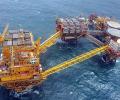
State-owned Oil and Natural Gas Corporation (ONGC) expects a USD 10.3 billion revenue boost from increased oil and gas production, achieved through a partnership with UK's BP in the Mumbai High field.

Chinese import tariffs have unwittingly come to India's assistance to help boost imports of US liquefied petroleum gas (LPG) at rates cheaper than what it pays for supplies from West Asia, according to industry sources and shipping data.

On Thursday, Oil Minister Dharmendra Pradhan had stated that the government was reworking the subsidy-sharing formula.

Maruti, IndusInd Bank, Bajaj Finserv, Eternal, Mahindra & Mahindra, Tata Steel, Kotak Mahindra Bank, Titan, HDFC Bank, and NTPC were among the other major gainers. Bharti Airtel and Sun Pharma were the laggards.
'We plan to add over 100,000 square kilometres every year, to reach an ambitious target of 500,000 square kilometres by 2025.'

RIL, its partner BP plc of UK will invest about Rs 6,000 crore (Rs 60 billion) by 2016 to help sustain and improve recovery from the two main gas fields.

She shares the milestones, routines and insights that defined her fitness journey and the lessons she learnt along the way.

BP Plc has won a bid to operate ONGC's giant Mumbai High oil and gas field by offering up to 60 per cent increase in output over baseline, the state-owned firm said on Wednesday. State-owned Oil and Natural Gas Corporation (ONGC) had in June last year floated a tender seeking foreign partners to reverse declining output at its flagship Mumbai High fields, offering a share of revenue from incremental production plus a fixed fee but not any equity stake.

India's Oil and Natural Gas Corp expects crude output to rise 15 per cent to 600,000 barrels per day in 2006-07 but production from its ageing fields will fall rapidly in subsequent years, a company official said.\n\n\n\n

According to a new subsidy sharing formula, the payout of upstream oil producers like ONGC is to be reduced to the extent of Rs 4,500 per tonne oil development cess they pay to the government, sources privy to the development said.

The two sides are also likely to firm up a currency swap framework and seal several other agreements including one on debt restructuring following talks between Modi and Sri Lankan President Anura Kumara Disanayaka on April 5, people familiar with the matter said.

Margins for the oil refining and retailing sector have moved off their peaks, and the average integrated margins (refining plus marketing) for oil marketing companies (OMCs) have normalised. The ascent in crude oil prices, combined with static retail prices, has depressed marketing margins for diesel and petrol. However, the fall in marketing margins has been offset by increased gross refining margins (GRMs).

After a robust 2023, foreign investors significantly scaled back their investments in Indian equities in 2024, with net inflows amounting to over Rs 5,000 crore, as elevated domestic valuations, coupled with geopolitical uncertainties prompted investors to adopt a more cautious stance. Looking ahead to 2025, FPI flows into Indian equities could see a recovery, supported by a cyclical upswing in corporate earnings, particularly in domestic-oriented sectors like capital goods, manufacturing, and infrastructure, Vinit Bolinjkar, head of research, Ventura Securities, said.

Lack of clarity on the overhaul of the subsidy-sharing mechanism by upstream companies.

The FMCG industry hopes for a revival in consumption growth in 2025 with some 'green shoots' already visible, after having a challenging year amid escalating input costs and a double-digit rise in food inflation, which ultimately slowed down the pace of the urban market growth in the second half of 2024. Soaring prices of commodities such as palm oil, coffee, cocoa and wheat forced FMCG players to go for a hike of 3 to 5 per cent or resort to shrinkflation by reducing pack sizes and grammage to retain attractive price points, fearing a volume loss.
The new government may also introduce a separate scheme for revival of stranded gas-based power projects
A swift recovery in oil demand in India is not only helping the stability of the global market, it is giving huge fiscal headroom to the government in terms of additional excise duty.

Oil and Natural Gas Corporation has deployed the best-in-class technologies in its Improved Oil Recovery and Enhanced Oil Recovery schemes on these fields.

Petrol and diesel prices were cut by Rs 2 per litre each as state-owned oil companies ended a nearly two-year-long hiatus in rate revision, just hours before the general election schedule was announced.
Cairn India, which found India's largest oil field in Rajasthan in over 30 years, has discovered a saline water reservoir near its oil field that will help pump crude oil to the ground level and enhance production.

Finance Minister Nirmala Sitharaman on Thursday said the government is close to reaching saturation in implementing social sector schemes designed to provide basic necessities to the poor. Addressing the students of Hindu College on the occasion of its 125th anniversary, she said the time has come for India to become economically 'aatmanirbhar' (self-reliant) and march forward to becoming a developed nation by 2047. Regretting that 60 years since Independence passed without any sense of urgency, Sitharaman said, "We have laid the material foundation for a Viksit Bharat" and empowering people by providing basic necessities to all.

Re-instatement of 5% custom duty on crude imports will help.

Data used for the graph and cited elsewhere in the column were obtained from various publications of the RBI.

Capital expenditure by 54 large central public sector enterprises and five departmental arms, having a capex minimum target of Rs 100 crore, rose 93 per cent year-on-year (YoY) in the April-May period to Rs 1.39 trillion. The National Highways Authority of India (NHAI) and the Railways have started this financial year's capex cycle on a stronger note. In the first two months of FY24, the 54 CPSEs, along with the departmental arms, achieved 19 per cent of their combined budget target of Rs 7.33 trillion, Business Standard has learnt.

India's current account deficit is expected to deteriorate in the current fiscal on account of costlier imports and tepid merchandise exports, according to the Finance Ministry's monthly economic review. The review released on Thursday by the ministry also said that global headwinds would continue to pose a downside risk to growth as crude oil and edibles, which have driven inflation in India, remain major imported components in the consumption basket. For the present, it said, "their global prices have softened, as fears of recession have dampened prices somewhat. This would weaken inflationary pressures in India and rein in inflation."

Billionaire Mukesh Ambani's Reliance Industries Ltd on Friday reported a 46 per cent jump in net profit for the three months ended June on the back of bumper earnings from oil and telecom businesses. The oil-to-retail-to-telecom conglomerate's consolidated net profit rose to Rs 17,955 crore during April-June period -- the first quarter of 2022-23 fiscal year -- from Rs 12,273 crore in the year-ago period, it said a stock exchange filing.
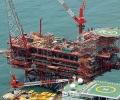
The government is pushing the public sector behemoth ONGC to involve private sector companies and service providers wherever possible to help raise oil and gas production, Petroleum Secretary Tarun Kapoor said Thursday. Kapoor's comments came days after the second-highest ranked official in his ministry asked Oil and Natural Gas Corporation (ONGC) to give away a 60 per cent stake plus operating control in India's largest oil and gas producing fields of Mumbai High and Bassein to foreign companies. "ONGC has to explore more so that it can discover more oil and gas reserves and bring them quickly to production to raise domestic output. The government is very clear that ONGC has to do more," he told reporters.

Maintaining a rapid pace of the vaccination drive and quickly bridging healthcare infrastructure gaps across both urban and rural areas would emerge as the most sustainable stimulus for durable recovery of the Indian economy, says a report by the department of economic affairs.
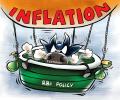
'While intensification of fuel prices and broad-based domestic cost pass-through pressures is a downside risk, core inflation is expected to strengthen further as demand recovers to pre-Covid levels,' the ministry said on Friday.

Equity benchmarks extended their decline for the fourth straight session on Wednesday, with the Sensex falling 214.85 points after the Reserve Bank raised the key interest rate by 50 basis points. Continuous foreign fund outflows and surging crude oil prices also weighed on markets. The 30-share BSE benchmark dropped 214.85 points or 0.39 per cent to settle at 54,892.49.

The Reserve Bank's growth projection for next financial year is lower than 8-8.5 per cent projected by the finance ministry in the recent Economic Survey which was tabled in Parliament on January 31. Unveiling the bi-monthly policy, RBI governor Shaktikanta Das said, "Recovery in domestic economic activity is yet to be broad-based, as private consumption and contact-intensive services remain below pre-pandemic levels."

The central government is likely to exceed the budgeted tax collection target of Rs 22.2 trillion for the current fiscal year, led by better indirect tax mop-up, compliance measures, and recovery in most sectors following the second wave of the Covid pandemic. Personal income and corporate tax collections (net of refunds) grew 74 per cent to Rs 5.70 trillion in the first half of the current financial year, driven mainly by advance tax and TDS payments. The target for the current fiscal year is Rs 11.08 trillion; higher taxes are paid usually towards the end of a fiscal year.

The applications range from disaster recovery to predicting demand and understanding customer choices using artificial intelligence.
 © 2026 Rediff.com - Advertise with us - Disclaimer - Privacy Policy - Sitemap - Feedback - About us - Terms of use - Grievances